
Why W-9s Cause So Many 1099 Headaches for Group Therapy Practices

It's January, and you're getting ready to prepare your practice's 1099s.
You have 5 contract clinicians on your list. You collected W-9s when they were onboarded. You have their information in QuickBooks. It seems like this should be a quick job.
Then you get to Hannah Abbott, and something doesn't quite match.
QuickBooks says Godric's Hollow Counseling LLC. The W-9 in your file says Hannah Abbott, and it's dated 2023.
Now you have a question to answer before you can move forward with the 1099.
And that one question can turn into an email, a follow-up, a new W-9, another review, and more time spent tracking down information you thought you already had.
If you want a refresher on what a W-9 is for, it's step 2, "Collect the information you need to make the decision," in [Preparing 1099s for your group therapy practice](link to step 2).
That's also where you first met Hannah, and where I said her mismatch wasn't necessarily a problem but did need a closer look. This is the closer look.
Your W-9 is doing more than collecting a tax ID
The W-9 gives you a name, a tax classification and a taxpayer identification number (TIN). Your 1099 runs on all 3.
And the name and the number have to belong together. The IRS checks.
4 ways a W-9 goes wrong
A missing W-9 is the obvious one. There are 3 others:
Missing: You never collected a W-9.
Incomplete: You collected one, but the information isn't complete or clear.
Inconsistent: The W-9 says one thing while your vendor or payment records say something else. (That's Hannah.)
Stale: Something about the contractor or their business has changed since they signed it. (Maybe Hannah. You can't tell from the file.)
The last two are easy to overlook because you technically do have a W-9.
That's where "we already have their W-9, so we're good" gets practices into trouble.
What happens when the information doesn't line up?
Hannah joined your practice as a contractor in 2023. You collected her W-9 and saved it. Check.
Two years later, Hannah formed Godric's Hollow Counseling LLC and asked you to start paying the business.
Someone updated the vendor record in QuickBooks. Nobody asked for a new W-9.
It's a quick ask. It's also easy to forget when you have 47 other things on your desk.
That ordinary update, made in 2025, is where this 1099 problem actually starts.
Your bookkeeping records now show Godric's Hollow Counseling LLC, while the W-9 you have on file lists Hannah Abbott.
To you, this might seem obvious. You know Hannah and you know Godric's Hollow is her business.
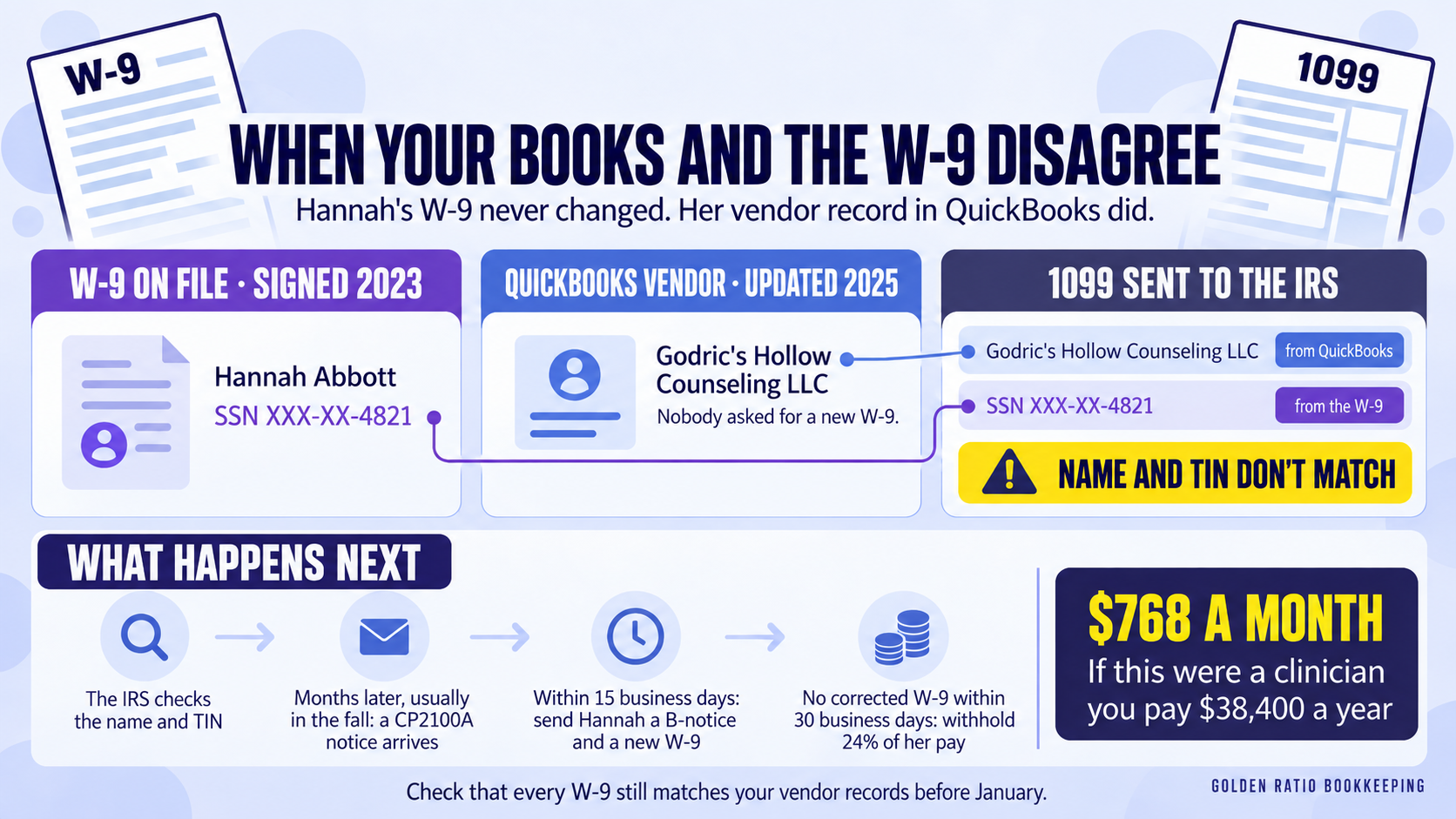
Here's the frustrating part. Hannah's W-9 might be completely fine. If forming the LLC was the only thing that changed, it probably is.
But nothing in your file tells you that. Someone has to stop and figure out whether the information on file still reflects Hannah's current tax information.
Which answer is right depends on how her LLC is taxed, and that's worth confirming with your tax professional. I'll cover it in the next article.
Your bookkeeping software can organize the information you have. It can't tell you which name is right.
What happens if the name and TIN don't match
Here's how the gap turns into a real problem.
Say nobody stops to ask Hannah in January, and the 1099 goes out with the new business name and the information from her 2023 W-9.
Your 1099 software pulls the name from the vendor record, so the form says Godric's Hollow Counseling LLC. The TIN comes from the W-9, so it's Hannah's Social Security number.
The IRS checks every 1099 against its own records. That LLC name and Hannah's SSN don't match anything it has.
Months after you file, usually in the fall, you get a letter: a CP2100A notice listing Hannah's form as a mismatch. (Practices with fewer than 50 forms with errors get the "A" version.)
Then the clock starts.
Within 15 business days, you send Hannah a "B-notice" and a blank W-9.
If she hasn't returned a corrected, signed W-9 within 30 business days, you have to start backup withholding: 24% of every payment you make to her, sent to the IRS instead of to her.
If the same mismatch happens again within 3 years, a new W-9 isn't enough. She has to give you a copy of her Social Security card or an IRS Letter 147C confirming her EIN.
Hannah's $2,400 year makes that annoying. Now picture the same mismatch on a clinician you pay $38,400 a year. Backup withholding is $768 a month, $9,216 over the year.
And you're the one who has to tell her.
The 1099 itself can also draw a penalty for incorrect information. For 2026 forms, that's $60 per form if you fix it within 30 days, $130 if you fix it by August 1, and $340 if you fix it after that or never.
Having a W-9 on file, and answering the B-notice on time, is part of how you show the IRS you did your job. If a notice shows up, call your tax professional before you do anything else.
Her W-9 never changed. Your books did.
Do you need a new W-9 every year?
Usually no, you don't need a new W-9 every year. But you do need current information when something changes what you report.
Forming an LLC on its own may not change anything on Hannah's W-9. These can change the information her 1099 depends on:
Electing a different tax treatment for her LLC, like an S-corp
Changing her legal name
Getting a different TIN
A new address is a records update. Change it in QuickBooks so her 1099 reaches her. A new business name is trickier, because that's exactly the change that tripped up Hannah's 1099.
The PDF in your folder can't tell you whether any of those happened. Only Hannah can.
A simple W-9 problem can turn into a January scavenger hunt
Once you discover an inconsistency, someone has to deal with it.
Find the old W-9. Compare it to QuickBooks. Email Hannah. Wait. Follow up. Review the new form. Update the vendor record. Then get back to the 1099.
Each step takes 2 minutes. They happen across 2 weeks. The work is easy. The interruptions add up.
And that's the cheap version, the one where you catch it in January.
Sometimes you get an opening. Hannah emails to update the bank account for her payouts, and that's your moment to ask for a fresh W-9.
More often, she doesn't say anything. It's business as usual for her. Then in April, her tax pro questions the 1099, and now you're sorting it out after the forms are filed.
Who finds the problem first
If January is the first time anyone looks closely at your W-9s, that's when you'll find every problem at once.
If you don't find them in January, the clinician's tax pro finds them in April. Or the IRS finds them in the fall.
Hannah's 1099 problem started in 2025, the day her vendor record changed. January is just when it shows up.
Check your W-9 file this week
Pull up your contractor list in QuickBooks and the W-9s in your file. Compare them one contractor at a time and find your row:
| What you find | What it means |
|---|---|
| No W-9, or one missing the TIN, signature or tax classification | Request a complete W-9 before you prepare or file the 1099. |
| The W-9 and QuickBooks agree, and you don't know of any changes | You're probably in good shape. |
| QuickBooks shows a new business name, but the W-9 doesn't | Ask the contractor what changed. It may be nothing. (That's Hannah.) |
| The contractor changed their legal name, TIN or tax classification | Get a new W-9 before you file. |
| You're not sure which name and TIN belong together | Stop before filing. That's a question for your bookkeeper or tax pro. |
If 2 records disagree, stop there. Guessing which one is right is exactly how Hannah's 1099 went out wrong.
It takes about 20 minutes for 5 contractors.
There's one more check that practices filing on their own almost always skip. The IRS has a TIN Matching system that confirms a name and TIN combination before the 1099 is filed. It could have caught Hannah's form in January, not in the fall. You have to register with the IRS to use it, so it rarely happens unless your filing service, like Track1099, includes it. I run it for every client before their 1099s go out.
When something doesn't line up, it gets harder from there. Even a fresh W-9 can come back with a different name or a new EIN, and now you have a new question. Working out which name and TIN belong on the form, getting a corrected W-9, and answering an IRS notice if one arrives is the part we handle for our bookkeeping clients.

The W-9 is one step in a longer process.
If you want to see the whole thing, from figuring out who needs a 1099 to getting it filed, start with Preparing 1099s for Your Group Therapy Practice.