
Hiring an Employee in Another State? Here’s What Your Therapy Practice Needs to Know

A client of mine hired a clinician who lived in California. She started May 18.
Good hire. Everybody was happy.
We didn't get the practice's California EDD employer account number until August 18. Three months.
In between, the Q2 payroll tax return came due. It's due July 1 and delinquent after July 31, and we had no account number to file under. So we missed it. The overdue payroll tax deposits finally went in on August 20, once the account existed.
No notice has shown up yet. It might.
California charges a 15% penalty on late payroll tax payments, plus interest, and there are a few other penalties stacked behind that one. Their penalty reference chart has the full list if you want it.
On one clinician's 6 weeks of wages, that adds up to a few hundred dollars. Annoying, not fatal.
And that's the part I want you to sit with. The money was never the problem.
My client isn't careless. He's busy. He runs a practice, he sees clients, and the registration paperwork sat on his list underneath 40 other things. This is the second time a new-state registration has run late for him. Both times he apologized and moved on, because from where he sits it looks like a small administrative miss.
From where I sit, it's 3 months of a payroll account that couldn't file, a quarter to amend, and a deadline nobody could do anything about.
He did what most owners do: found someone he wanted, put her in the payroll system, and assumed the software would sort out the rest. Most of the time, the software does.
Then one employee moves the whole thing sideways.
What actually changes when your employee lives in another state
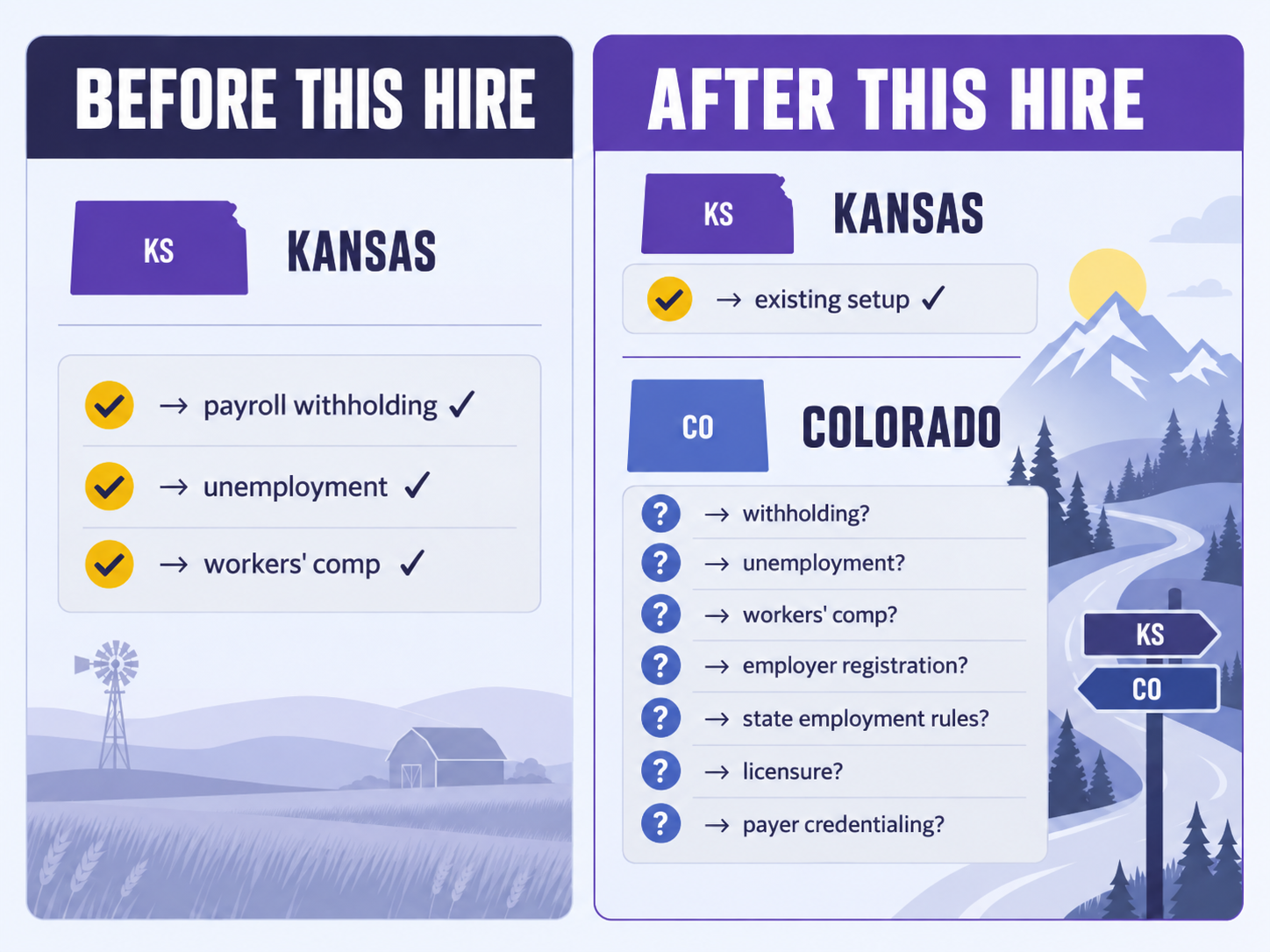
Say your practice is in Kansas. You have 4 clinicians on payroll, you use Gusto, payroll runs every 2 weeks without you thinking about it. You find a 5th clinician you really want.
She lives in Colorado.
Where an employee physically does the work is what usually drives this. Your practice doesn't need an office there. It doesn't need a single client there. She just has to be sitting in Colorado when she works.
The details do vary. Some states have reciprocity agreements, some have thresholds, and states without an income tax skip the withholding piece entirely. The new state's own employer guidance is what settles it.
You already handle federal payroll as an employer. Colorado adds its own set on top:
State payroll withholding
State unemployment registration and taxes
New-hire reporting
Workers' compensation coverage
Employer or business registration
State-specific employment rules (pay frequency, leave, wage rules, expense reimbursement)
And 2 more that have nothing to do with payroll but run on the same clock. I'll get to those in a minute.
The specifics change by state. The shape doesn't: one employee can create a whole second state to manage.
The 4 questions to ask about any state
You'll do this again. Colorado this time, maybe Texas or Oregon the next. So hold onto the framework instead of the Colorado specifics.
1. Where will she physically sit when she works? That's the state whose rules you're dealing with, whatever state your practice or your clients are in.
2. What does that state need from me before payday? Withholding, unemployment, workers' comp, new-hire reporting, business registration.
3. What does she need before she can see a client? A license valid in that state, and credentialing with your payers there.
4. Who is doing each piece, and by when? This is the one that gets skipped.
Same 4 questions every time. Only the answers change.
Before you send the offer letter, find out what the new state requires
You're not going to learn Colorado employment law before you hire one clinician. You do need to know which questions to ask.
1. State payroll withholding. If the state has an income tax, you'll almost certainly need a withholding account there. How long does it take to get one?
2. State unemployment. Do you need to register as an employer in the new state and pay unemployment tax there?
3. Workers' compensation. Your policy lists the states it covers. Is the new one on it? A handful of states require coverage through a state fund rather than a private carrier, so "I'll just add it to my policy" isn't always an option. Ask your broker before you assume.
4. New-hire reporting. Every state has a new-hire reporting system. Where does she get reported, and by when?
5. Business registration. Does employing someone in the state create registration requirements beyond payroll?
6. State employment rules. Pay frequency, sick leave, final paycheck timing, expense reimbursement. Some states are much more particular than others.
7. Licensure. Is she licensed to practice in the state she's sitting in, and which state's clients can she see? More on this below, because it's the one that can stop the hire cold no matter how clean your payroll setup is.
One more to raise with your tax professional, and it comes with a piece of jargon. "Nexus" means having enough of a presence in a state that the state gets to tax your business there. An employee working from that state can sometimes be enough on its own, which can mean a state business return you've never filed before. Whether it actually applies depends on the state and on your situation, so ask before you hire rather than at tax time.
Understand all of this before she starts. Most of it won't change your mind about the candidate.
Can you just make her a contractor instead?
This is usually the next thought, and I get why. A 1099 looks like it skips the whole problem.
Classification depends on the facts of the working relationship, not on which box is easier for you. If she does the same work, on your schedule, with your clients, in your EHR, under your supervision, she looks like an employee. Crossing a state line doesn't change that, and some states, California among them, apply tests that are harder to satisfy than the federal ones.
Worth a real conversation with your attorney or payroll provider before you decide. Getting it wrong costs more than registering correctly would have.
Payroll software helps. Don't assume it handles everything.
If you use Gusto, adding a new state looks like entering an address.
Here's the actual screen:
Two dropdowns. "Works from home." Then "Please select..." for the work state.
Gusto even flags it right there, in small print: if working from home, ask Gus about potential impacts on your business. That's the software quietly telling you there's something to look into. It's also very easy to click past.
There's an important distinction between processing payroll and setting up the infrastructure that lets you process payroll correctly. Think about the pieces separately:
Payroll calculation: How much should she be paid, and what should be withheld?
State registration: Does your business need to open employer accounts in the new state?
Tax filing: Who submits the returns and payments?
HR and employment compliance: Which state-specific rules apply to her?
Your payroll provider handles some of these, depending on your plan and what you've signed up for. Some will register you in a new state, often for an added fee. Some will only file once you've registered yourself and handed them the account numbers.
So the question is: do you know exactly which pieces your provider handles and which pieces are still yours?
That's the part you don't want to find out after she's already started. It's exactly what happened with my California client. The payroll system was ready to file. The account number it needed was never created, because creating it was on his side of the line.
Who actually handles what
By now you have a list of things that need doing and no obvious person to call about any of them. Here's roughly who owns what. Your setup might split these differently, which is exactly why it's worth asking.
Your payroll provider. Calculates pay and withholding, and usually files and deposits once the accounts exist. Ask: do you register me in a new state, or do I do that and hand you the numbers?
Your bookkeeper or financial team. Watches whether the new accounts are feeding into your books correctly, whether the filings are actually going out, and what the hire is doing to your cash. Ask: what do you need from me before her first payroll, and by when?
Your tax professional. Nexus, state business returns, entity questions. Ask: does employing someone in this state change what returns I file?
Your insurance broker. Workers' comp in the new state, and malpractice coverage that follows her there. Ask: does my current policy cover an employee working in this state, and what changes if it doesn't?
An employment attorney or HR adviser. Worker classification, offer letters, and the state employment rules that vary the most. Ask: what does this state require that mine doesn't?
Her licensing board. Whether she can practice in that state and whose clients she can see. That one is hers to confirm, but you want to see the confirmation before day 1.
Your biller or credentialing contact. Payer panels in the new state and how long they take. Ask: what's the realistic timeline, and which payers are slowest?
Nobody on that list sees the whole picture. Your payroll provider doesn't know your credentialing timeline. Your biller doesn't know your filing deadlines. Your broker doesn't know either one.
Someone has to be tracking whether all of the pieces are actually moving, on a calendar, against a start date. Usually that's you, unless you've deliberately handed it to somebody.
Licensure and credentialing run on their own clock
Here's the part a general payroll article won't tell you, and it's the part that matters most for a therapy practice.
Licensure. She needs to be licensed to practice in the state she's working from, and generally in the state where her client is located too. There are interstate compacts for psychologists, counselors, and social workers that can simplify this, but which states participate varies by profession and it changes. Check with her licensing board, and check early. You can have every payroll account open and ready and still have a clinician who legally can't see a client.
Payer credentialing. If she'll be billing insurance, she needs to be credentialed with your payers in the new state. Being on your panels in Kansas does nothing for her in Colorado.
How long credentialing takes is outside my lane, so I won't guess at it. Ask your biller or your credentialing contact what it's been running lately for the payers you work with. Get a real number before you build a revenue projection on top of it.
That number matters more than anything else in this article. Here's why.
What the hire actually costs
Let's say she's projected to generate $9,000 per month. Her compensation and employer payroll taxes come to $5,500.
$9,000 − $5,500 = $3,500 per month
Easy yes.
That math assumes she's billing on day 1.
If credentialing in the new state takes 3 months, she isn't. You're paying $5,500 a month for a caseload that's still filling. Depending on how fast she ramps and how much cash-pay work she can pick up in the meantime, you could be $8,000 to $12,000 out of pocket before that $3,500 a month starts showing up.
Run that number with the real credentialing timeline your biller gives you. It's the one that decides whether this hire is comfortable or tight.
There are real setup costs too. Your time or your bookkeeper's time getting the accounts opened. A workers' comp policy adjustment. State filing fees. Then an addition to your quarterly filing routine, because once you're registered in Colorado you're filing in Colorado, quarter after quarter, until you close the account. Closing one has its own process, usually a final return and some paperwork, and that varies by state too.
None of that makes the hire a bad idea. For a clinician who'll generate $120,000 a year, a second state is a reasonable cost of growth, and widening your recruiting pool past your home state might be exactly what gets you the right person.
Now run the same math on a different hire.
You want a remote admin in Colorado for 5 hours a week. Same registrations. Same accounts. Same quarterly filings for as long as the account is open. She generates no billable revenue at all.
That's the one where the infrastructure costs more than the person contributes, and where the answer is probably to hire in your own state instead.
Same paperwork, opposite conclusion. That's the whole framework.
What costs you is finding out in week 3 that you can't run payroll. A $200 registration fee has never killed a good hire.
Give yourself more lead time than you think
State registrations take time, and how much varies a lot.
Kansas is a useful benchmark. The Department of Revenue tells businesses to allow 2 to 3 weeks for an application to be processed, and to begin the process 3 to 4 weeks before your start date, so the certificate is issued before any tax payments come due.
That's a state telling its own businesses to start a month out. Assume at least that for a state you've never dealt with.
Here's how fast this gets uncomfortable:
June 3: Candidate accepts offer
June 5: Owner discovers a state registration is required
June 14: Registration is still pending
June 17: Planned start date
June 21: First payroll needs to be processed
Now what?
You run payroll, because she worked and she needs to get paid. But the filing goes in late or doesn't go in at all, because there's no account number to file under. Then you're looking at a late-filing notice, penalties and interest, and an amended filing to clean up once the account finally opens. All of it lands on your desk weeks after you'd stopped thinking about the hire.
My California client lost 3 months. Same shape, longer timeline.
The time to look into this is when you're seriously considering the candidate. Not the night before her first payroll.
What should be confirmed before she starts.
The list up top is what to research before you make the offer. This one is different. This is what you want resolved before her first day:
You know where she'll physically perform the work
You know which state's payroll taxes and withholding apply
The necessary employer accounts are open, with numbers in hand
Unemployment registration is complete
Workers' comp coverage is confirmed for that state
Your payroll system has the state account numbers entered
Her license is valid in the state she's working from
Credentialing is either complete or you've planned around the gap
You know who is responsible for the ongoing filings and payments
One clinician across a state line builds a second set of accounts, filings, and deadlines under your practice. That's the part to see before you make the offer.
Because "we'll just add her to Gusto" is a lot easier to say than it is to clean up after the fact.
Your next step
Most of what goes wrong here comes down to one thing: nobody was sure whose job it was.
If you’re already working with us, loop us in as soon as you’re seriously considering an out-of-state candidate, ideally before the offer goes out.
And if you’ve ever wondered who on your financial team is supposed to catch something like this, there’s a good place to start.

Not sure who should handle what?
Bookkeeper, CPA, or fractional CFO? Here’s how their roles differ in your therapy practice.