
When Is It Time to Hire a Bookkeeper for Your Therapy Practice? One Owner’s Story

What actually changed for a group practice owner after she stopped doing the books herself, including the parts that didn't change.
I asked a client recently what problem she had when she came to us.
She thought about it for a second and said: "I did not know what I was doing. And I did not know how badly I was doing it."
Elizabeth owns a growing therapy practice. Several clinicians, insurance-based, telehealth. She's smart, she's careful, and she was the one keeping the books. She knew bookkeeping wasn't her strength. What she didn't know was what good bookkeeping was supposed to look like in the first place.
If you're reading this, you're probably somewhere in that same spot. You suspect you've outgrown doing it yourself. You're just not sure the monthly fee is worth it, partly because you can't picture what someone would actually be doing for that money.
So here's the honest version of Elizabeth's story, told by someone with an obvious stake in the answer.
Before we get into it, a quick gut check. Three questions:
Is your EHR's number the number you think of as revenue?
When was the last time you reconciled?
Is there a financial question you've been avoiding because you're not quite sure how to answer it?
Elizabeth was three for three. Hold onto your answers, because the fuller version of that checklist is at the bottom.
The uncomfortable middle
Elizabeth didn't hire us and feel instant relief. She hesitated. For a while.
The math didn't look obvious to her. Bookkeeping wasn't going well, sure, but the price of doing it properly was real money leaving the practice every month. And even now, a year and half in, she'll tell you: "Sometimes when it comes out, I'm like, dang, that's a lot of money going out right in that one thing."
That's a fair reaction. I'd rather say it out loud than pretend the fee disappears once you see the value.
What got her over the hump was starting small. Before she was a full client, we met a few times and I walked her through the bare minimum she should be doing to keep her own books honest. Reconciling. Checking her numbers against the bank instead of trusting the software.
She tried it. And trying it is what showed her the gap.
"If I hadn't baby stepped in to see, oh gosh, this is something I am really failing at, and then having to do it myself and trying and not even doing it well." She wouldn't have known otherwise.
What she was actually doing before
Here's the specific thing she was getting wrong, and it's extremely common.
She was running her practice off her EHR's numbers instead of her bank's.
Her practice management system told her what she'd billed. She treated that as revenue. Reasonable, right? The system says you provided $25,000 of services in June, so June was a $25,000 month.
Except your EHR is tracking sessions and charges. It isn't tracking what the payers actually paid, what they clawed back, what's still sitting in accounts receivable, what a client on a payment plan still owes, or what got denied and never resubmitted.
That $25,000 might land as $18,000. It might land across three different months. Some of it might never land at all.
Nobody reconciles that gap for you automatically. If you don't do it, or hire someone who does, you're running a business on a number that describes work performed instead of money received. Those are different businesses.
One clarification, because these get tangled together. Your P&L and your bank balance are never going to match each other, and they aren't supposed to. That's timing. Work happens in June, the money lands in July, and both reports are telling the truth about different things. The EHR problem is a separate one: those are charges that were never going to collect at face value, and no amount of waiting turns them into cash.
The other half of what she was doing before was quieter. She'd hit something in the books she didn't understand, and she'd keep going.
Her words: "Well, that's hard, and I don't understand that, but I'm sure it'll work out in the end."
That's what happens when you're the only person looking at something you were never trained to look at. The unanswered question doesn't feel urgent, so it goes in the pile, and the pile lives in the back of your head at 11pm.
When the cost finally made sense
The reframe that got her there was time.
Here's how she put it: "I'm spending this many hours. I could see one more client a week and pay for that."
Let me make that concrete with an illustrative example (these aren't Elizabeth's real numbers, just round ones to show the shape of it).
Say professional bookkeeping runs you $500 a month. Say your average session nets the practice $130 after payer adjustments.
If handing off the books gives you back roughly an hour a week, that's four more sessions a month. $520. The bookkeeping covered itself, and you got the hours back on top.
I want to be careful here. That math worked for Elizabeth because she had demand she wasn't serving and hours she was burning on reconciliation. If your caseload isn't full, freed-up hours don't automatically convert to revenue, and you should run your own version of that calculation before you assume it does.
But it's the right question to ask. Better than "can I afford this," which has no answer.
Bookkeeping became a Monday task
This is the part I think about most, because it's so ordinary.
Elizabeth blocks Monday mornings for working on the practice. Our questions land in her inbox on Monday. She answers them while she still has bandwidth, and then she's done.
"If it came Tuesdays one week and Wednesdays another week, that would get lost. But if it comes into my inbox and I have the bandwidth and the space to do it, I just click it off on Monday and then it's just part of the routine."
The predictability is doing a lot of work there. Bookkeeping stopped being an ambient worry and became a recurring 20-minute appointment.
And she's not scanning for what she might have missed, because she knows the questions will find her. When she signed a big marketing contract, her reaction was: "I know she's going to ask me about this later, so I will be able to pinpoint it."
My favorite detail is a small one. Every so often something doesn't match and she has to go dig up a claim in an insurance portal. She used to do that constantly. Now she opens the site and blanks.
"I forget how to do it sometimes. I'm like, what is my password? I don't even know which system this is."
That's what delegation actually looks like from the inside. You lose the muscle memory for the task, because you stopped doing the task.
Here's what that means for you. An open financial question takes up the same amount of room in your head whether it turns out to matter or not. You carry the "what was that $2,400 charge" with the same weight as the thing that could actually hurt you, because you have no way to tell them apart. A predictable Monday email sorts them for you. That's the part you're paying for that never shows up on an invoice.
The tax-season test
This is where the value stopped being theoretical for her.
Before, tax time meant a request from her tax professional for a document she couldn't identify, and a spike of dread that something enormous was hiding in the numbers. She had a stretch with a previous tax pro who went quiet on her entirely, which did not help.
She described the fear pretty vividly: "It's going to fall out, we're going to owe $100,000 in taxes and we're going to lose our house."
Now the handoff runs through us. We prepare the financial side and get her tax professional what they need. When a form request comes in that she doesn't recognize, she forwards it to me and asks.
Her assessment after this past filing season: "Okay, I think we're in the right."
That's the sentence I'd put on the wall. A practice owner who believes her own numbers.
I should be clear about the boundary here, because it matters. We don't file her return, and we don't replace her tax professional. Clean books make their job possible. The return, the planning, and anything complicated still belongs with the tax pro. Your situation, your entity, and your state all change the answers.
Which is worth sitting with if you've been counting on your tax professional as the safety net. A good one will scrutinize what you send and ask questions. But the questions they're able to ask depend on the quality of what's in front of them. Hand them clean books and their attention goes to your actual return. Hand them a file with holes in it and a chunk of their time goes to reconstructing your year first, which is slower, more expensive, and a worse use of what they're good at.
What didn't magically change
If I stopped the story here, it would be marketing.
Elizabeth's business is still hard. Right now she's working through a clinician leaving to start her own practice, two clinicians whose caseloads aren't filling, a significant Google Ads investment she's three months into, insurance receivables she's still fighting a payer over, and real pressure to bring more income home to a family with teenagers heading toward college.
She's behind on estimated tax payments. She told me so on the same call where she said everything else.
She still feels financial anxiety. Her own words: "I just sit with that anxiety constantly."
So the honest claim is narrower than "hire a bookkeeper and stop worrying about money." Running a group practice comes with hard financial decisions, and no bookkeeper takes those off your plate.
What changed is that she can have a hard decision without also wondering whether the numbers underneath it are wrong.
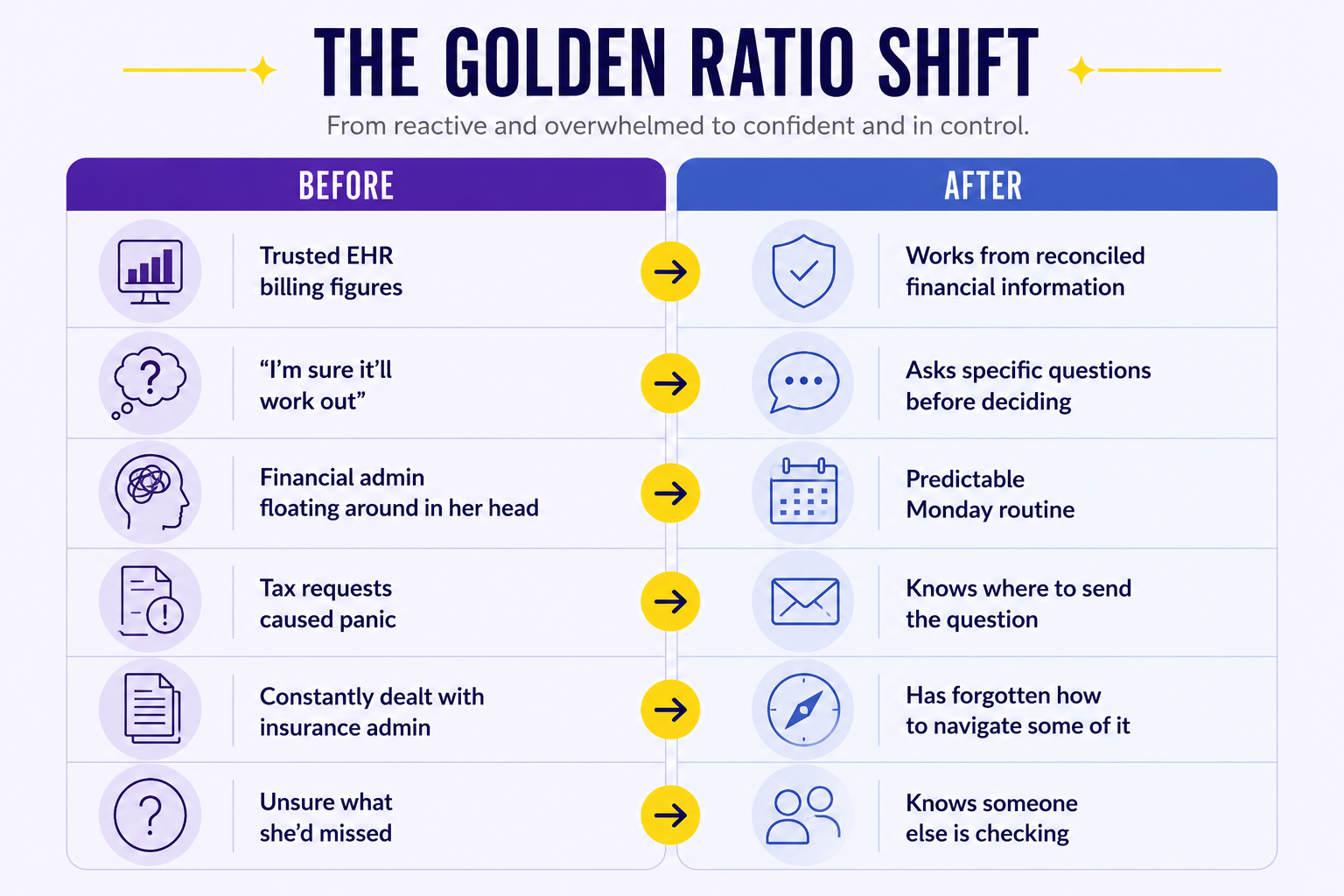
The question she asks now
Here's the clearest before-and-after in the whole story.
She has a clinician leaving who has clients on payment plans. Elizabeth wants to pay her out and close the chapter cleanly rather than carry her on payroll into next year.
Two years ago, that would have been "I'm sure it'll work out in the end."
What she asked instead: how much is still outstanding, how long does collection typically take, and what's the risk if we pay her out before every dollar comes in?
We landed on a plan. Wait about 30 days past her exit, since days-in-AR has been running around 20 to 30. Then sit down, total up what's genuinely still collectible, and pay out against that number with eyes open about the small piece that might get written off.
That's a real business decision made with real information. All it took was someone handing her the receivables picture and talking it through with her.
Same owner, same instincts, same practice. What's different is that she had a number in front of her. Every owner I know is already asking good questions in their head. Most of them just have nowhere to take those questions, so the questions turn back into "it'll probably work out."
She still isn't a "numbers person"
Elizabeth will tell you flatly that she doesn't understand every metric we send her. Some of the reporting doesn't map neatly onto how she thinks about her practice, and she says so.
That's fine. That's the arrangement.
"I feel confident that even if I miss something, you're going to catch it. And I obviously miss a lot of things."
You don't have to understand accounting before you're allowed to hire an accountant. Waiting until you do is a great way to spend three more years guessing. You need to understand enough to run your practice. Somebody qualified watches the rest and tells you when to look up.
Worth being blunt about this one, because it holds a lot of owners in place. The literacy was never the entry requirement. Hiring someone is usually how owners get financially literate, not something they earn the right to first.
How to know if you're where she was
Short list. If several of these are true, you're past the point where DIY is saving you anything:
You suspect the books aren't right but couldn't say what's wrong.
Tax season makes your stomach drop.
Your EHR or your bank balance is functioning as your financial system.
You don't reconcile monthly, or you're not sure what reconciling means.
You're doing financial admin during hours you could be seeing clients.
You're running payroll or bringing on clinicians.
You're looking at reports without knowing whether to believe them.
You're making growth decisions on numbers you haven't verified.
If I had to compress every one of those into a single line, here it is.
The right time to hire a bookkeeper is when the quality of your financial information starts setting a ceiling on the quality of your decisions.
That's the threshold. It has nothing to do with hitting a revenue number or a clinician count. You'll know you've crossed it the first time you're facing something real, hiring, raising your own pay, signing a lease, paying out a departing clinician, and the honest answer to "what do the numbers say" is "I'm not sure the numbers are right."
You can be a sharp operator with great instincts and still make a mediocre call, because the information you're working from is mediocre. That's the cost, and it doesn't show up as a line item anywhere. It shows up as the hire you delayed six months too long and the clinician you paid out before the money came in.
Elizabeth's version, when I asked what she'd say to someone sitting where she used to sit:
"It is worth it for peace of mind. I understand the feeling that you can't, because it costs a lot of money. But I feel like it has saved my bacon in the end."
Where that leaves you
There are probably two of you reading this, and you need different things next.
If you're still on the fence, what's usually missing is a picture of the arrangement itself. What you'd hand over, what stays yours, what a normal month looks like once it's running. Read What it's really like to work with a bookkeeper for your therapy practice. It walks through onboarding week by week and what actually lands on your plate.
If you recognized your own practice somewhere in Elizabeth's story, the next useful thing is finding out whether bookkeeping is genuinely your problem. Sometimes it is. Sometimes the books are in decent shape and the real issue is caseload, or pricing, or comp structure.
That's what a diagnostic review is built for. It's a focused look at what's actually going on in your books right now. Whether your accounts are accurate. Whether revenue is categorized in a way that fits a group practice instead of the generic default. Whether clinician comp and payroll are landing where they should. Whether your reconciliations are real. You come out of it with a prioritized list of what's working, what's leaking, and what to fix first.
Start with a discovery call. We'll talk through where your practice actually is and whether a diagnostic makes sense as your next move.
That's close to how Elizabeth started, and it's the whole reason she was able to see her own gap. Nobody talked her into anything. She just got a clear enough look at her books to decide for herself.

Ready to see what’s really going on in your books?
A clearer picture starts with knowing where you stand. Let’s take a look at your practice, talk through what you’re noticing, and figure out what would be most helpful from here.